
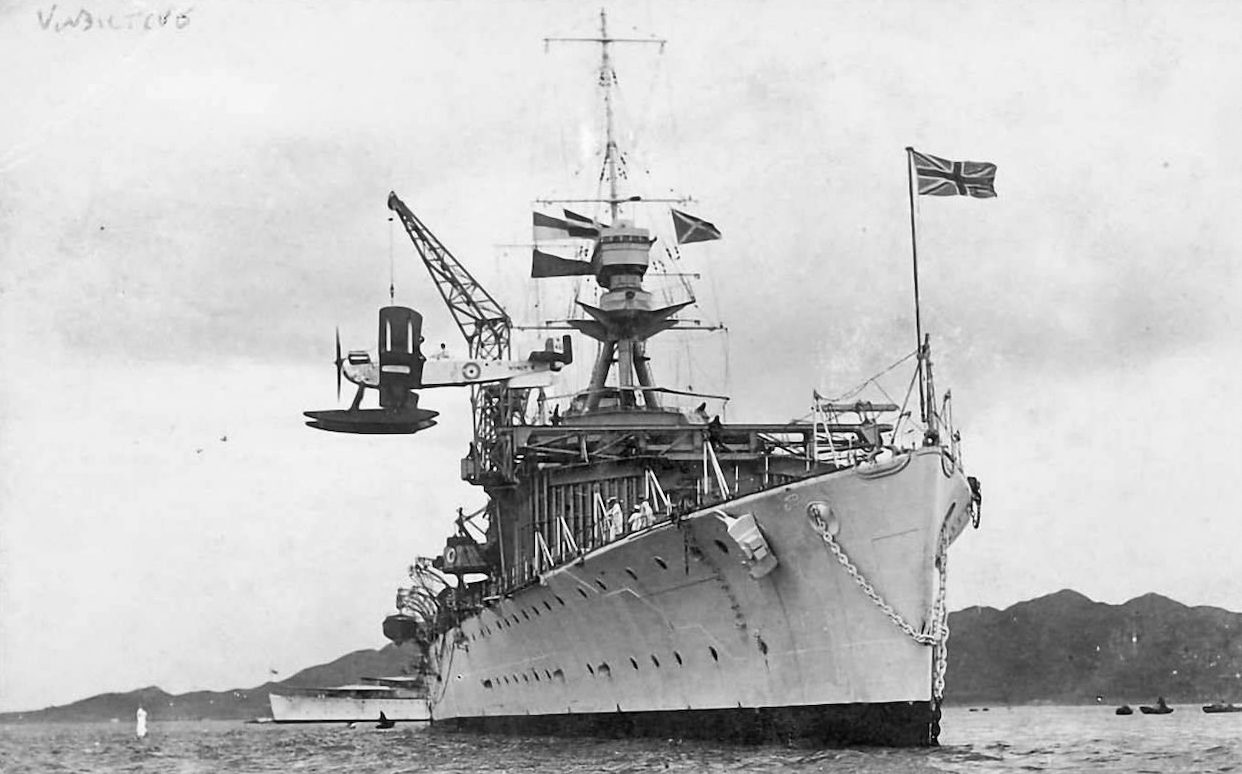
Sub-Lieutenant Brock Joins HMS Vindictive at the China Station in 1926
Sub-Lieutenant Brock Joins H.M.S. Vindictive at the China Station in 1926
Patrick Willet Brock served the first few years of his naval career in the Mediterranean, and then in 1925 he applied for a transfer to China. To protect British trade, citizens and vast commercial holdings in China at this time of unrest, Great Britain carried out “Gunboat Diplomacy”. PWB travelled from Vancouver to Shanghai on the Canadian Pacific Steamship, Empress of Australia. He wrote letters to his brother describing his first few months in China where he was assigned to the Royal Navy cruiser H.M.S. Vindictive.
Resources
For more information on the topic of this programme and the sources used, please use the links below. You can also read an article created from the audiogram below the links.
For Posterity’s Sake: A Royal Canadian Navy historical project dedicated to the men and women of the Royal Canadian Navy and the ships they lived and served in. https://forposterityssake.ca/
The Dreadnought Project: Naval history wiki focusing on naval history in the period 1880-1920. https://www.dreadnoughtproject.org/
Canadian Navy List: on CFB Esquimalt Naval & Military Museum website. https://navalandmilitarymuseum.org/archives/publications/the-navy-list/
Britain’s Forgotten Naval Port in China – Weihaiwei: https://www.youtube.com/watch?v=FuhQYA8iw8g&t=2s
Valour Canada: Not-for-profit organization that educates young Canadians about our shared military heritage. https://valourcanada.ca/
Historical Photographs of China: University of Bristol virtual photographic archive of China. https://hpcbristol.net/
Virtual Shanghai Project: research and resource hub dedicated to the history of Shanghai from the mid-nineteenth century to the present day. https://www.virtualshanghai.net/
Quotes are transcribed as written without correction for current spelling, standards or sensibilities.
Canada Brock Joins H.M.S. Vindictive on the China Station
by K.M. Lowe
Canada Brock’s Arrival on the China Station
In 1925, after spending the formative years of his naval career in the Mediterranean, twenty-three-year-old Sub-Lieutenant Patrick Willet Brock applied for a transfer to the Royal Navy’s China Station. The traditional “treaty-port” system was collapsing under the weight of surging Chinese nationalism, and Great Britain had responded by intensifying its “Gunboat Diplomacy.” This policy involved the strategic use of naval force—both implicit and explicit—to safeguard British trade, citizens, and vast commercial holdings during the early, volatile years of the Chinese Civil War.
Brock received his orders while at home on leave in Canada and departed from Vancouver aboard the Canadian Pacific Steamship Empress of Australia, arriving in Shanghai in early 1926. Though he had expected to serve on the river gunboat HMS Moorhen, his orders were changed at the last minute. He was instead assigned to the cruiser HMS Vindictive.
For the 23-year-old Sub-Lieutenant Brock, the spring of 1926 was a time of acclimatization and observation. He witnessed the simmering tensions resulting from the previous year’s “May Thirtieth Movement,” which was a series of anti-imperialist strikes and boycotts—and prepared for the more direct naval actions that would come later.
The “Bolshevik” Cruiser: Life Aboard the Vindictive
HMS Vindictive was a ship with a complex identity. Originally designed during the First World War as a heavy cruiser, she was converted into an aircraft carrier while still under construction, only to be rebuilt back into a conventional cruiser between 1923 and 1925. By 1926, she was a fully armed cruiser with a complement of over seven hundred men, including thirty-seven officers.
The Vindictive arrived in China from England trailing a cloud of scandal. In December 1925, sensationalist headlines in England and Canada claimed mutiny on board. Newspapers reported that the socialist anthem “The Red Flag” had been sung by ship personnel and labelled the Vindictive a “Bolshevik ship.” In an essay called, “Notes on Vindictive,” Brock wrote the following about the incident.
“In the winter of 1925 to 26, I was on leave in Canada after having had a very good commission in a smart cruiser flagship in the Mediterranean. I noted casually one day a headline in the local rag: “Bolshy Ship of the British Navy!” Underneath was a photograph of HMS Vindictive and a confused and rambling statement that there had been a communistic outbreak in the ship and had now acquired a reputation of being “red.” …The reported Bolshevism was as greatly exaggerated as the reports of Mark Twain’s death.”
Brock wrote that the fallout of the incident led to a change in captain. However, the timing of leadership change may not line up with actual events. George Francis Hyde had been in command of Vindictive during some of 1925, but by the time Brock joined the ship, it was captained by Ronald Howard, a veteran who had commanded the vessel once before in the early 1920s.
Familiar Faces
Despite being thousands of miles from home, Brock found familiar company on the Vindictive. Among the officers on board was Francis Robert Woodcock “Jack” Nixon. Born in Duncan, B.C. in 1904, Nixon attended the Royal Naval College in Esquimalt at the same time as Brock.
Although two years younger than Brock, the two had joined HMS Orion together in 1920. According to a story on the website, For Posterity’s Sake, Nixon had been given permission to start his career early to support his widowed mother.
The Vindictive also carried the Honourable Walter Seymour Carson, son of the famous Irish unionist Lord Carson, who had served on HMS Orion with Brock and Nixon.
Bock and Nixon were not only friends, but Brock was the best man at Nixon’s wedding held in Victoria, BC in 1928. Tragically, while Brock’s career would see him retire as a Rear Admiral and live into his 80s, Jack Nixon would meet a different fate. Nixon was killed in 1941 when the troopship S.S. Nerissa was sunk by a German U-boat off the coast of Ireland.
The Seasonal Migration: From Shanghai to Wei-hai-wei
In the spring of 1926, the Vindictive was anchored in the Huangpu River, the naval hub of Shanghai. However, as the sweltering summer approached, the Royal Navy followed a strict seasonal migration to avoid the “oppressive heat and disease” (such as malaria and cholera) prevalent in Shanghai and Hong Kong.
In a letter to his brother, Brock described the ship’s problematic departure from the “Fairy Flats”—the historical English name for the treacherous Tongsha sandbars at the mouth of the Yangtze.
“To turn in the narrow and crowded Whangpoo River, we had to go up at slack water to a bend in the river, let go an anchor, and swing with the assistance of the first of the flood. All would have been well if the river were emptier, but the flood swept us down on a steamer at anchor and she had to veer clear. Then proceeding downstream, a steamer shoved off from the jetty without considering us, and the tide bore us over to her side and we scraped along her. All our boats were out, and might have been crushed to matchwood, but they escaped with a few scratches. We got down to Woo-sung where the Whangpoo joins the Yangtze about 1300 hours, and then had to anchor and wait for the next flood tide before we could pass the Fairy Flats at the mouth of the river. Considering that the Yangtze brings down something like one million tons of mud per day, the wonder is that the entrance is not more silted up than it is. You can see the yellow colour of the river water eighty or a hundred miles out to sea.”
Their destination was Wei-hai-wei, a British-leased “health resort” and naval outpost 457 nautical miles north of Shanghai. Wei-hai-wei, and specifically Liugong Island (Liu-kung Tao) at the mouth of the bay, served as the official Royal Navy summer training ground. For the crew of the Vindictive, this was a period of conducting drills and gunnery practice in a cooler climate to ensure the ship was fighting-ready before deploying to dangerous, pirate-infested hotspots.
Muscle and Workhorses of the Station
While heavy cruisers like the Vindictive provided the muscle for major diplomatic shows of force, the daily “piracy patrols” fell to smaller vessels like HMS Moorhen, HMS Woodlark and HMS Bluebell, all mentioned in Brock’s letters. Late in 1926, Bluebell would gain fame for rescuing the hijacked British steamer Sunning from pirates—a story that made headlines across the Empire.

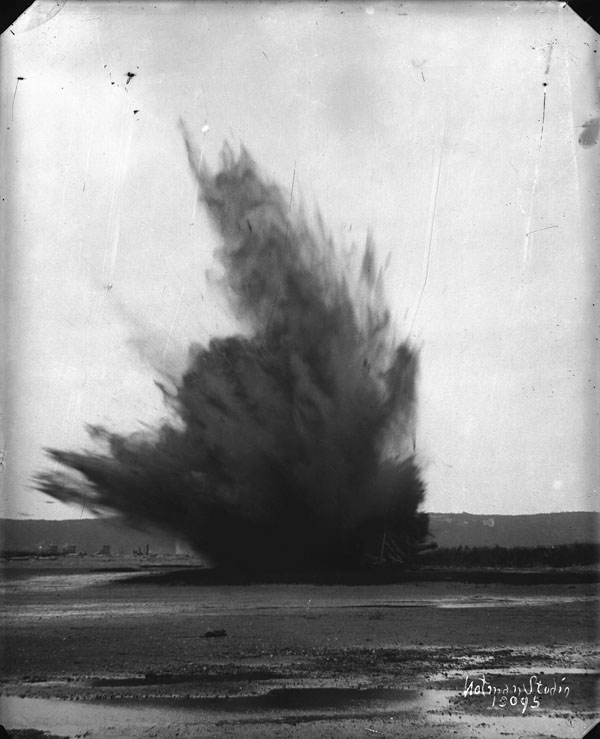
Navy Cadet Brock's Eyewitness Account of the Halifax Explosion of 1917
Canada Brock - Halifax Explosion of 1917
On the 6th of December 1917, two ships collided in the Halifax harbour and caught fire. One of the ships carried explosives for the Great War raging in Europe. The burning vessel drifted toward the Halifax shore, attracting crowds of spectators unaware of the danger. A few minutes after 9 AM, the fire reached the main cargo hold, triggering a detonation of 2.9 kilotons of explosives. The blast flattened everything within a 2.5 kilometre radius, and the shockwave was felt hundreds of kilometres away. On that December morning, Patrick Willet Brock was a 14-year-old cadet at the Naval College, located on the Halifax harbour. PWB recounted this historic event in journals he kept throughout his years at the naval college.
Resources
For more information on the topic of this programme and the sources used, please use the links below. You can also read an article created from the audiogram below the links.
Excellent Article at Legion Magazine: https://legionmagazine.com/features/halifax-explosion/
Halifax Explosion: https://maritimemuseum.novascotia.ca/what-see-do/halifax-explosion
Nova Scotia Archives: https://archives.novascotia.ca
History of the Canada’s Royal Naval College: https://canadiansatarms.ca/history-of-the-rcn/
Royal Military College of Canada, which holds originals of PW Brock’s journals: https://www.rmc-cmr.ca/en
Canadian Forces Base Esquimalt Naval & Military Museum: https://navalandmilitarymuseum.org/
The Halifax Explosion
by K.M. Lowe
The Halifax Explosion on the 6th of December 1917 remains the deadliest man-made disaster in Canadian history. The event is still considered the largest accidental non-nuclear detonation in recorded history. The disaster was caused by a harbour collision between the Norwegian vessel SS Imo and the French munitions ship SS Mont-Blanc, which was carrying high explosives for the Great War in Europe.
Patrick Willet Brock (PWB), a 14-year-old cadet at the Royal Naval College, witnessed the event and wrote about it in the journals he kept throughout his years at the naval college.
The sheer scale of the casualties was immense, particularly considering Halifax’s population at the time was only about 60,000. Nearly 2,000 people were killed—about 1,600 died instantly, and hundreds more succumbed to their injuries later. The dead included more than 500 children and 200 military personnel, many of whom were working at the dockyards. Approximately 9,000 others were injured, with hundreds blinded after watching the burning ship from their windows only to have the blast shatter the glass inward. Many others suffered ruptured eardrums and severe burns. But the crisis went on for days. They weren’t just dealing with the largest man-made blast of the pre-atomic age—they faced a merciless blizzard, a medical crisis, and a frantic search for answers in the wreckage.
The physical destruction was equally staggering.
- The Blast Zone: 325 acres (1.3 square kilometres) of the city’s North End were completely obliterated.
- Buildings: Over 12,000 buildings were damaged, with 1,630 of those completely levelled.
- Housing Crisis: 6,000 residents had their homes destroyed, and 25,000 were left with inadequate shelter.
- Economic Cost: Property damage was estimated at $35 million in 1917 ($700–$800 million today), though the modern replacement cost of the entire district—including docks, railways, and factories—would likely reach billions.
PWB wrote, “Outside points were most generous in their aid. As soon as possible. The injured were sent by train to Truro and other points, where the citizens were most kind to the sufferers. The way in which the United States sent their aid was very generous. Relief trains and ships were despatched.”
Truro, Nova Scotia, sent a relief train within the hour, while Moncton and Saint John dispatched firefighters, equipment, and medical personnel by rail that same afternoon. Prince Edward Island granted $8,000 for relief and sent a contingent of nurses to assist the city’s overwhelmed hospitals.
Perhaps the most famous assistance came from Boston, Massachusetts. Governor Samuel McCall did not wait for a formal request, immediately telegraphing, ”Understand your city in danger… Massachusetts ready to go the limit in rendering every assistance you may be in need of.”
The governor also did not wait for a reply. Before nightfall, a relief train loaded with doctors, nurses, and supplies departed Boston. This forged a bond between Nova Scotia and Massachusetts that remains strong over a century later. In gratitude, Nova Scotia sends a large Christmas tree to Boston every year. In 2025, a 45-foot white spruce was officially lit in the Boston City Common on December 4th, just two days before the anniversary of the explosion.