
Bourke at the Blockship Raid of May 1918
Roland Bourke's Personal Account of the Blockship Raid of May 1918
In a letter to his brother written in October 1918, Victoria Cross and Distinguished Service Order recipient Roland Bourke describes the 1918 blockship operations. A member of the Royal Navy Volunteer Reserve, Bourke served on motor launches in Larne, Ireland and Dover, England during the First World War. In the spring of 1918, Bourke was captain of His Majesty’s Motor Launch 276, rescuing blockship crews at the raids on Ostend, Belgium. This episode recounts the second blockship operation that targeted Ostend, which began on May 9, 1918 and ended the following morning on May 10, 1918.
Audiogram Subjects
Below is a list of the people and ships mentioned in the audiogram for reference.
People
Subjects mentioned in these programs include the following and information about most of them can be found in various places online and in the article below this section.
- Roland (Rowland) Richard Bourke, VC, DSO (1885-1958)
- Sir Ion Hamilton Benn, 1st Baronet, CB, DSO, KStJ, TD (1863–1961)
- Arthur Reginald Marsden Lower, CC FRSC (1889–1988)
- Keith Robin Hoare, DSO (1890-1959)
- Alfred Edmund Godsal, DSO, Croix de Guerre (1884–1918)
- Sir Victor Alexander Charles Crutchley, VC, KCB, DSC, DL (1893–1986)
- Roger John Keyes, First Baron Keyes, GCB, KCVO, CMG, DSO (1872-1945)
- Geoffrey Heneage Drummond, VC (1886-1941)
- Alexander McBain Young (1894 – 1950)
Vessels
The following vessels are mentioned in the video and in the article below.
- His Majesty’s Motor Launches
- HMS Vindictive
- HMS Warwick
Resources
For more information on the topic of this programme and the sources used, please use the links below. You can also read an article created from the audiogram below the links.
Videos
To watch more about the Blockship Raids of 1918 view the following videos.
- https://www.youtube.com/watch?v=TAeieqOOSng
- https://www.youtube.com/watch?v=awJlheqSIjY
- https://www.youtube.com/watch?v=g0VrSPzfbRM
- https://www.youtube.com/watch?v=XgkpYGS7M5E
- https://www.youtube.com/watch?v=lj6LP1weqZ0
- https://www.youtube.com/watch?v=0CMgVGPfQUQ
- https://www.youtube.com/watch?v=aCZaV-eUsjI
Websites
For more information on the topics covered in this program, visit the following websites.
- http://www.motorlaunchpatrol.net/written_accounts/despatches/ostend/
- https://history.blog.gov.uk/2018/04/23/the-raids-on-zeebrugge-and-ostend/
- https://www.naval-history.net/WW1Battle1804ZeebruggeOstend.htm
- http://www.greatwar.co.uk/battles/yser/zeebrugge-ostend-raid.htm
Books
If you prefer to read a book about the Blockship Raids of 1918, there are several modern accounts & vintage histories including the following.
- The Zeebrugge & Ostend Raids 1918 by Deborah Lake: This is one of the most accessible and thorough modern narratives of the entire operation. Written by a former RAF officer, it excels at breaking down the sheer logistical nightmare, the strategic context, and the planning failures of the raid. Lake meticulously tracks both the diversionary assault on the Zeebrugge Mole and the terrifying movement of the concrete-filled blockships (HMS Thetis, Intrepid, and Iphigenia) as they tried to navigate into the narrow canal mouth under devastating fire.
- The Raids on Zeebrugge & Ostend 1918 by C. Sanford Terry & Keble Howard: This modern republication combines two prominent wartime accounts written in the immediate aftermath of the 1918 events. It provides a fascinating look at how the British public and the Admiralty viewed the tactical success—and the intense human cost—of the blockship strategy just months after the smoke cleared.
The Blockship Operation of May 9, 1918
By K.M. Lowe
As noted in the previous post, in 1915, Roland Bourke was rejected by all Canadian military services due to his defective eyesight, which had been damaged in an explosion in 1907. Undeterred, he travelled to England in 1916 and talked his way into the Royal Naval Volunteer Reserve, where he was assigned to motor launches, often crewed by Canadians. Motor launches were eighty-foot wooden vessels designed for coastal defence and submarine chasing. Powered by petrol engines with a top speed of around 19 knots, they were typically armed with a single three-pounder and several machine guns.
A transcript of a letter written by Roland (often spelled Rowland) Bourke to his half-brother John in October 1918 is in the Canadian Forces Base Esquimalt Naval & Military Museum archives. The letter describes the block-ship raids that garnered Distinguished Service Order and Victoria Cross medals for Roland while he served in the Royal Navy Volunteer Reserve (RNVR).
Bourke had been assigned to motor launches as a Sub-Lieutenant, but was promoted to Lieutenant in command of His Majesty’s Motor Launch 341 at Larne, Ireland. In November 1917, he transferred to Dover, taking command of Motor Launch 276. Dover in England, and Dunkirk in France functioned as a single tactical unit for the Dover Patrol. Dover was the administrative and logistical heart, as well as the primary repair yard and safe harbour behind the Dover Barrage, a massive anti-submarine net and mine system. Dunkirk was the frontline springboard as it was significantly closer to the German-occupied Belgian ports.
By 1918, Germany’s unrestricted submarine warfare was close to starving Britain into submission. The inland Belgian city of Brugge served as a massive protected nest for German U-boats and destroyers. The block-ship operations in the spring of 1918 were designed to obstruct the Zeebrugge and Ostend channels with obsolete ships, packed with concrete and rubble. The April 23rd operation had been partially successful at Zeebrugge. But at Ostend, the ships did not reach their target. So in May, they tried again.
The Courage of Roland Bourke
Immediately after the April 23rd raid, Bourke put in for leave to go home to Canada, which was approved by his commanding officer, the Dover Patrol Captain, Sir Ion Hamilton Benn, First Baronet. Benn was the commander of a flotilla of motor launches in the Dover Patrol for three years during the First World War. Benn’s wartime service was recognised with the Distinguished Service Order, appointment as a Companion of the Order of the Bath and the Croix de Guerre. His motor-launches played a major role in the spring 1918 raids by creating chemical smoke-screens and rescuing crews from the block-ships.
But as soon as his leave was approved, he learned that there would be a second blockship operation. He immediately put his leave on hold and volunteered. He wrote in the letter that he learned Commander Godsal had again volunteered.
Alfred Edmund Godsal, Distinguished Service Order, Croix de Guerre, had served on a variety of ships in the Mediterranean, West Indies, and China Station, and by 1914, was an elite officer. Godsal was promoted to Commander at the age of 32, and volunteered for the 1918 blockship operations. During the operations on April 23, 1918, Commander Alfred Godsal was in command of the First Ostend Raid—the simultaneous sister operation to the more widely known Zeebrugge Raid. He led the assault force and captained the obsolete cruiser HMS Brilliant, which was packed with concrete and intended to be used as a blockship to seal off the German-held canal entrance at Ostend. Unfortunately, the Ostend portion of the April 23rd operation was unsuccessful when the blockships ran aground before reaching their targets.
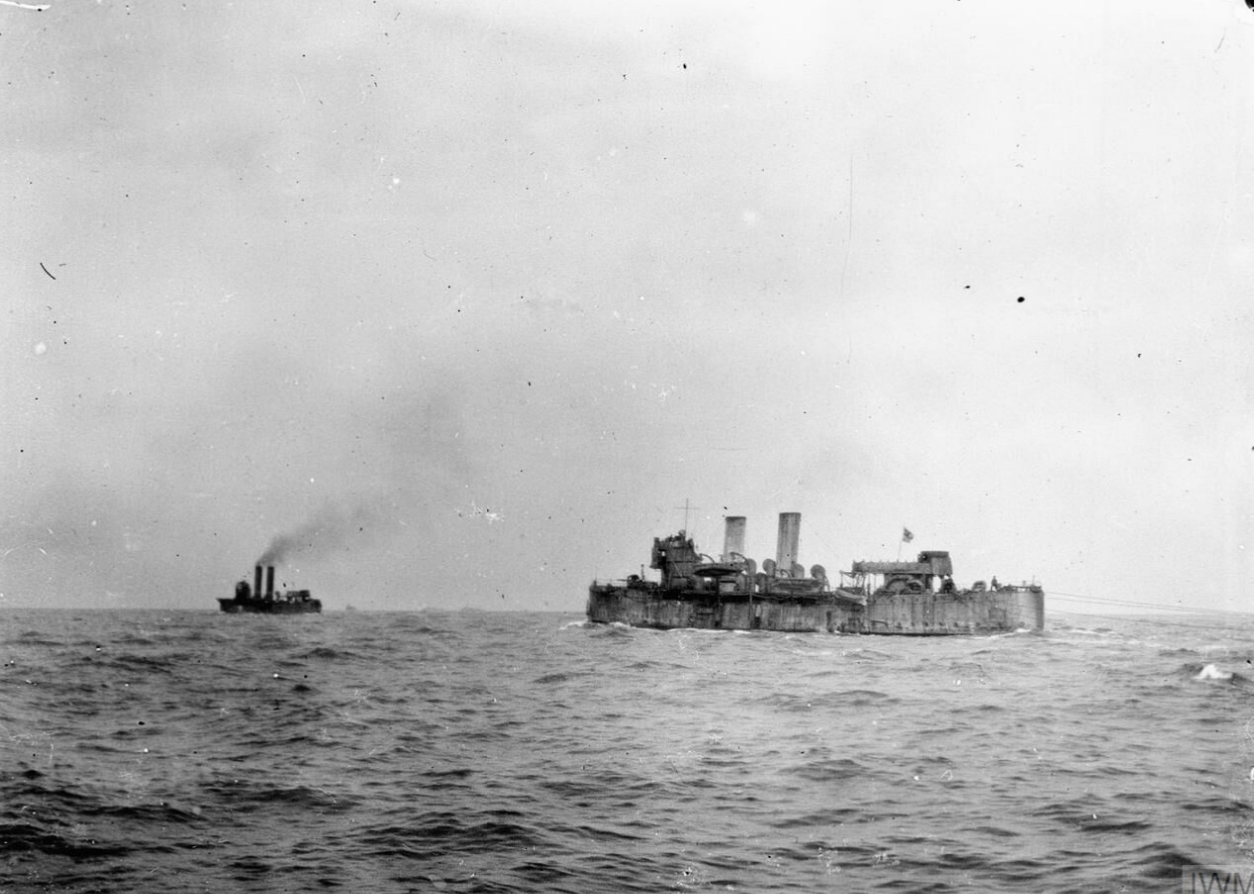
After HMS Vindictive was designated as the blockship for the second Ostend Raid, Godsal volunteered to captain her. Vindictive had been the main assault vessel during the April 23rd Zeebrugge blockship raid. But the ship had been so damaged by German shelling that she was converted into a blockship for the second raid, which would target Ostend.
In lectures after the war, Bourke explained that all the participants in the blockship raids had volunteered for the operations. As a blockship, HMS Vindictive was manned by volunteers mostly drawn from the crews of HMS Brilliant and HMS Sirius from the previous blockship operation. Bourke noted that his motor launch crew had declined to volunteer for the second Ostend operation.
“Sub-Lieutenant Young and my crew did not care to volunteer again. And the Senior Officer Dunkirk reported my motor launch was too damaged for the work. So the Commanding Officer and crew of ML 245 who volunteered were chosen. There was, however, a vacancy on 245 as First Lieutenant. So I volunteered to wave my command and go with her in that capacity.”
They stood by at Dunkirk waiting for a favourable wind, which did not materialize. The winds would have been necessary for the smoke screens necessary to get the operational fleet to the channel without being seen by the Germans on shore. After a week with no favourable wind, they returned to Dover and had a few days leave.
“On returning from leave, I was informed I must not go as Drummond’s Number One. But might act as standby if I could get my motor launch in shape in time. This was giving me 24-hours notice. And as I had stripped my motor launch for ML 245, and my dynamo was out of action, it was not giving me much time. Anyway, I got together all the gear, such as rope mattresses, shrapnel helmets, Lewis guns, etcetera, etcetera, and also got the dynamo from another launch which was out of action. Also a complete new volunteer crew gathered from here and there, and was ready on time and crossed to Dunkirk. We then had ML 245 and ML 128 as rescue, and ML 283 and ML 276 as standby.”
Hastily prepared, Vindictive sailed with another cruiser, HMS Sappho, intended as a second blockship. But Sappho had to turn back due to engine trouble. The support fleet left Dunkirk and carried out creating smoke screens while HMS Vindictive made for the shore.
“ML 128 and ML 283 standby failed to find her in dense smoke. Consequently, there was ML 245 and ML 276 with her as she went in. On account of thick smoke and mist, Vindictive got within one-quarter mile of the piers without seeing them. And Commander Godsal, rather than risk putting his ship aground outside harbour, turned and maneuvered.”
Vindictive was guided in part by flares and supporting motor launches under heavy German fire and challenging conditions, including smoke, mist, and strong defences. As Vindictive approached the Ostend piers, massive heavy shells from inland batteries rained down from miles away, while field guns and rhythmic thumping anti-aircraft pom-poms shredded her superstructure at point-blank range. A relentless blizzard of machine-gun fire and snipers came from the piers, all illuminated by the blinding flickering glare of German searchlights cutting through the artificial smoke.
“For close on forty minutes, Commander Godsal maneuvered his vessel in this shoal water. Sometimes the searchlights got him, and the guns opened on him at point blank range. He would dodge into a smoke bank, and the batteries continued to put down a barrage. Finally he found the harbour, and put her right in between the piers and started to turn her. Although the shell fire, pom-pom, and machine gun fire were terrific, Commander Godsal left the armoured conning tower in order to see better in the smoke. A shell struck the conning tower at this moment and killed him in the hour of achievement. He was one of the finest men I have had the honour of meeting, and I greatly regret his death. The smoke was so thick that in following the Vindictive, I got to the east of the eastern pier and had to turn and go round to the other side. In the meantime ML 254 had gone to Vindictive and got her crew. As I went in, she came out and I shouted to know If they had everyone. Crutchley, on whom the command had developed when Godsal was killed, answered yes, he had. But I did not hear him. I thought someone might have been overlooked, so went into the harbour and turned, shouting to see if I could get a reply. We thought we heard someone, but could not be sure. And then as we heard nothing, started out of harbour. And again we thought we heard someone, so put back. We could not however locate where the shouting came from and thought it might be the wily Hun trying to detain us till we were quite done in, so started out again. We started to leave the harbour three times altogether before we finally located Lieutenant Sir John Allen and two seamen in the water, hanging to the end of an upended boat. We maneuvered along side and got them, and started out of harbour, full speed, both engines. Just as we left the harbour, my compressed air tank was shot away. If this had happened a minute earlier, we could not have started our engines. Previously a six-inch shell had passed through my dinghy and exploded overboard but of course rendered the dinghy useless, so we certainly would have been done in.”
Captain Godsal had aimed to position Vindictive broadside across the channel to block it effectively. However, intense shellfire, which worsened the previous damage suffered at the Zeebrugge raid, disabled her port propeller and steering. She was sunk at an angle, only partially obstructing the channel. German forces could still use the channel with some difficulty, but it was a bold and costly effort that boosted British morale. Most of her skeleton crew was evacuated by motor-launches. Victor Alexander Charles Crutchley, who took over when Godsal was killed, was a career navy officer with ties to the British monarchy. By 1918, he was already a veteran; Crutchley eventually rose to Admiral in the Second World War and was knighted for his service. Total British casualties were relatively light compared to the earlier Zeebrugge Raid with eight dead, 10 missing and 29 wounded.
“My steering-hand had been killed at the wheel next to me, and another of my four deck-hands killed. Sub-Lieutenant Petrie, my volunteer Lieutenant, acted splendidly throughout the operation. When the landing-hand was killed, Petrie immediately took the wheel, and only relinquished it when I gave the orders to open fire on the piers with Lewis guns. He then, among other things, shot all the glass out of the lighthouses on each pier. Later, Petrie was the first, when we located the men in the water, to jump down and help to get them aboard. This was all under heavy machine-gun fire and pom-pom fire. Later, he did good work looking after the gassed and wounded men. My port acid-tank had again been pierced, and as my water-hose had been shot away, I could not sluice acid overboard. So that about two hours after leaving Ostend, it had eaten its way through the deck into the after cabin. And on contact with water in the bilges, started to smoke.”
When a monitor ship appeared near Bourke’s motor launch, he put his wounded and gassed men aboard her.
“I went alongside her blister, and her men waded over, carrying the surgeon who superintended the removal of the wounded, slung in stretchers. We then had to be towed on account of having no air to start engines again. We arrived at Dunkirk at 6.30 am, and again I was not sorry as I had been on the bridge twelve hours and had nothing to eat. All my remaining men had to go to hospital, gassed, but Sub-Lieutenant Petrie and I were alright. I had, after leaving Ostend, insisted on everyone being sick, as this is a great safeguard against results of poison gas. Luckily, there was no one to insist on my being sick, so I escaped that inconvenience.”
When Bourke examined his motor launch after arriving, he found more than 55 holes including 16 through the wheelhouse.
The actions of James Petrie, Temporary Sub-Lieutenant, Bourke’s first officer and second-in-command of ML 276, were critical to the success of the rescue. For his conspicuous gallantry, Petrie was awarded the Distinguished Service Cross. Petrie returned to Scotland for a few years after the war, then moved to Hong Kong where he founded the Hong Kong Naval Volunteer Force in 1933.
The Supporting Fleet and Aftermath
The destroyer HMS Warwick served as Admiral Keyes’ flagship during the blockade. Roger John Keyes, First Baron Keyes, GCB, KCVO, CMG, DSO, was commander of the Dover Patrol in 1918. Famous for altering tactics that resulted in the sinking of five U-boats in a month, he orchestrated the Zeebrugge and Ostend raids. As the first Director of Combined Operations in the Second World War, he was later instrumental in the formation of the British Commandos.
HMS Warwick was commanded by Captain Victor Campbell. After surviving Scott’s Antarctica expedition in 1911, Campbell served at Gallipoli, and then in May 1917 sunk a U-boat by ramming it. While navigating through the German-laid minefields outside Ostend following the operation, Warwick struck a mine, which nearly broke her in two. In a feat of seamanship often cited in naval history, the destroyer HMS Velox lashed herself to the side of the crippled Warwick and towed her across the English Channel. For his gallantry during the First World War, Campbell was awarded a DSO and two bars. In his further service with the Royal Navy, he reached the rank of captain.
When Geoffrey Drummond, commanding officer of ML 254, had reached the Ostend pier-heads earlier in the night, a shell exploded on his motor launch, killing his second-in-command, Lieutenant Gordon Ross, and a deckhand, and severely wounding the coxswain. Drummond himself was wounded in the head and legs by shell splinters. Despite his severe injuries and the fact that his boat was sinking, he successfully maneuvered alongside the Vindictive. He stayed on the bridge and oversaw the evacuation of two officers and 38 men. He then navigated the overcrowded and damaged launch out to sea, away from the German searchlights and batteries. He remained conscious and in-command until he reached the safety of the HMS Warwick, at which point he collapsed from exhaustion and blood loss. He survived the war, but died in 1941 due to a fall caused by the leg injuries he suffered during the Ostend raid.
“Well, I again put in for my leave shortly after this affair, and it was granted… A few hours after I left Nelson on my way back to England, a cable arrived saying I had been gazetted Distinguished Service Order for rescue of Brilliant’s crew and of ML 532 in the April 23rd raid. Shortly after my arrival back in England, I was gazetted Victoria Cross for rescue from the Vindictive. I forgot to say I was promoted Lieutenant Commander just before leaving for Canada. Recently I was decorated by the King with Victoria Cross and Distinguished Service Order, and had the honour of being the first of the 300 officers and men decorated. Lieutenant Drummond also received the Victoria Cross for his rescue. I have been back on duty now for several months and hope the war will end soon. I am fed up with the monotony and no signs of excitement. P.S. Of course, please don’t let any of this get into the papers.”
Vindictive’s wreck remained visible at Ostend, postwar. Her bow was later preserved as a memorial, and the May raid is marked each year in Ostend as Vindictive Day. Bourke’s wish for the war to end would come on the 11th of November, only a few weeks after he wrote the letter.

Bourke at the Blockship Raid of April 1918
Roland Bourke's Personal Account of the Blockship Raid of April 1918
The April 23, 1918 Blockship Raid, better known as the Zeebrugge Raid, was a daring British Royal Navy operation aimed at neutralizing the German-occupied Belgian port of Zeebrugge, a critical base for U-boats during World War I. While the raid was a masterclass in bravery and resulted in the awarding of eight Victoria Crosses, it was only a partial strategic success; the blockships were not positioned perfectly, and the German forces managed to clear a shallow channel around them within a few days. Nevertheless, the operation was a massive propaganda victory that significantly boosted Allied morale during a bleak period of the war. In a letter to his brother written in October 1918, Victoria Cross and Distinguished Service Order recipient Roland Bourke describes the 1918 blockship operations. A member of the Royal Navy Volunteer Reserve, Bourke served on motor launches in Larne, Ireland and Dover, England during the First World War. In the spring of 1918, Bourke was captain of His Majesty’s Motor Launch 276, rescuing blockship crews at the raids on Ostend, Belgium. This episode recounts the first blockship operation targeting Zeebrugge and Ostend, which began on April 23, 1918 and ended the following morning on April 24, 1918.
Audiogram Subjects
Below is a list of the people and ships mentioned in the audiogram for reference.
People
Subjects mentioned in these programs include the following and information about most of them can be found in various places online and in the article below this section.
- Roland (Rowland) Richard Bourke, VC, DSO (1885-1958)
- Sir Ion Hamilton Benn, 1st Baronet, CB, DSO, KStJ, TD (1863–1961)
- Arthur Reginald Marsden Lower, CC FRSC (1889–1988)
- Keith Robin Hoare, DSO (1890-1959)
- Alfred Edmund Godsal, DSO, Croix de Guerre (1884–1918)
- Sir Victor Alexander Charles Crutchley, VC, KCB, DSC, DL (1893–1986)
- Roger John Keyes, First Baron Keyes, GCB, KCVO, CMG, DSO (1872-1945)
- Geoffrey Heneage Drummond, VC (1886-1941)
- Alexander McBain Young (1894 – 1950)
Vessels
The following vessels are mentioned in the video and in the article below.
- HMS Brilliant
- HMS Iphigenia
- HMS Iris
- HMS Sappho
- HMS Sirius
- HMS Vindictive
- HMS Warwick
Resources
For more information on the topic of this programme and the sources used, please use the links below. You can also read an article created from the audiogram below the links.
Videos
To watch more about the Blockship Raids of 1918 view the following videos.
- https://www.youtube.com/watch?v=TAeieqOOSng
- https://www.youtube.com/watch?v=awJlheqSIjY
- https://www.youtube.com/watch?v=g0VrSPzfbRM
- https://www.youtube.com/watch?v=XgkpYGS7M5E
- https://www.youtube.com/watch?v=lj6LP1weqZ0
- https://www.youtube.com/watch?v=0CMgVGPfQUQ
- https://www.youtube.com/watch?v=aCZaV-eUsjI
Websites
For more information on the topics covered in this program, visit the following websites.
- http://www.motorlaunchpatrol.net/written_accounts/despatches/ostend/
- https://history.blog.gov.uk/2018/04/23/the-raids-on-zeebrugge-and-ostend/
- https://www.naval-history.net/WW1Battle1804ZeebruggeOstend.htm
- http://www.greatwar.co.uk/battles/yser/zeebrugge-ostend-raid.htm
Books
If you prefer to read a book about the Blockship Raids of 1918, there are several modern accounts & vintage histories including the following.
- The Zeebrugge & Ostend Raids 1918 by Deborah Lake: This is one of the most accessible and thorough modern narratives of the entire operation. Written by a former RAF officer, it excels at breaking down the sheer logistical nightmare, the strategic context, and the planning failures of the raid. Lake meticulously tracks both the diversionary assault on the Zeebrugge Mole and the terrifying movement of the concrete-filled blockships (HMS Thetis, Intrepid, and Iphigenia) as they tried to navigate into the narrow canal mouth under devastating fire.
- The Raids on Zeebrugge & Ostend 1918 by C. Sanford Terry & Keble Howard: This modern republication combines two prominent wartime accounts written in the immediate aftermath of the 1918 events. It provides a fascinating look at how the British public and the Admiralty viewed the tactical success—and the intense human cost—of the blockship strategy just months after the smoke cleared.
The Blockship Operation of April 23, 1918
By K.M. Lowe
In 1915, Roland Bourke was rejected by all Canadian military services due to his defective eyesight, which had been damaged in a explosion in 1907. Undeterred, he travelled to England in 1916 and talked his way into the Royal Naval Volunteer Reserve, where he was assigned to motor launches, often crewed by Canadians. Motor launches were eighty-foot wooden vessels designed for coastal defence and submarine chasing. Powered by petrol engines with a top speed of around 19 knots, they were typically armed with a single three-pounder and several machine guns.
Bourke had initially been appointed a Sub-Lieutenant but was quickly promoted to Lieutenant in command of His Majesty’s Motor Launch 341 at Larne, Ireland. In November 1917, he transferred to Dover, taking command of HMML 276. Dover in England, and Dunkirk in France, functioned as a single tactical unit for the Dover Patrol. Dover was the administrative and logistical heart, as well as the primary repair yard and safe harbour behind the Dover Barrage, a massive anti-submarine net and mine system. Dunkirk was the frontline springboard as it was significantly closer to the German-occupied Belgian ports.
By 1918, Germany’s unrestricted submarine warfare was close to starving Britain into submission. The inland Belgian city of Brugge served as a massive protected nest for German U-boats and destroyers. To reach the English Channel, these vessels traveled through two long canals that emptied into the sea at Zeebrugge and Ostend. The blockship operations in the spring of 1918 were designed to obstruct those channels with obsolete ships, packed with concrete and rubble. Royal Navy-led, featuring British Canadian and Australian personnel, with minor support from the French Navy, these were not raids for glory. They were a desperate defensive move to keep the Allies in the fight.
After his motor launch had been out of service for two months, Bourke returned to Dover. “I heard volunteers had been called for for special dangerous work, the nature of which was not specified. And of course I volunteered at once.” Bourke suffered several setbacks, including the smoke not working satisfactorily, his propellers being fowled by rope and initially not being chosen for the operation. But he persisted, and his motor launch was fitted with smoke gear and selected as backup rescue.
There were two types of smoke screens: chemical and oil. Chlorosulfonic Acid was stored in tanks on decks of Motor-Launches. The chemical was sprayed through nozzles into the ship’s engines or directly into the air. When the acid hit the moist sea air, sulphuric acid droplets and hydrochloric gas formed a dense mist. On larger destroyers, engineers restricted air intake to the ship’s boilers while injecting excess-fuel oil into the furnace, belching thick oily black clouds from the funnels. The British could layer these screens—white chemical-smoke to hide ships at water level, and black oil-smoke blocked spotters in towers or aircraft.
In his lectures after the war, Bourke emphasized that everyone involved in the blockship raids had volunteered for the operations. He noted that when the call went out for 1600 volunteers, they received 3500 applicants, even though they were told it was a suicide mission with the possibility that not one person would survive.
According to a newspaper account, the first expedition comprised seventy vessels and had 588 casualties.“To pass this great array of shipping through our own minefields, to keep station during the crossing, and to take the whole through the German minefields by means which cannot be described, afterwards accurately timing the various phases of the attack, was a wonderful piece of seamanship.”
The operation on the 23rd of April 1918 consisted of two raids to trap German U-boats and destroyers inside the canals using obsolete ships, stripped and packed with concrete and rubble. This was to ensure they settled on the sea floor when sunk and could not be easily moved or blown up.
One raid sailed three blockships into the Zeebrugge canal with the destroyer HMS Vindictive as the main assault vessel. Vindictive’s role was to storm the most heavily defended seawall in Europe, called The Mole. The objective was to distract the German defenders and silence the heavy gun batteries on the end of the Mole, letting the three blockships, HMS Thetis, HMS Intrepid, and HMS Iphigenia, slip past to the canal entrance.
The other raid saw HMS Brilliant and HMS Sirius a few miles down the coast at Ostend. Bourke was on stand-by for the Ostend raid, but because of the heavy smoke and a buoy moved deliberately by the Germans, the Ostend blockships ran aground far from the canal they were supposed to block.
Bourke’s recollections in the letter were focused on the raid on Ostend as that’s where his motor launch was sent.
“Well, at last a favourable night came, and we left harbour anchoring in Divisions outside… The fleet proceeded to Ostend, and motor launches carried out their programme, but blockships did not arrive.”
Bourke wrote that the fleet consisted of monitors with motor launches to make smoke screens for them. These left Dunkirk at dusk and took up their stations about 10 miles from Ostend. Then destroyers, motor launches and coastal motor boats proceeded to the vicinity of Ostend.
“The first duty of coastal motor boats, which are small and extremely fast, was to make smoke east and west of Ostend to screen the approach of the rest of the fleet. The motor launches, on arrival, took up this work. Some smoking from exhausts while under way, and some putting over smoke floats and keeping them replenished as necessary. The destroyers were on convenient positions to backup the motor launches if Hun destroyers attacked us.”
Monitors, designed specifically for coastal bombardment, were used to produce smokescreens and keep the Germans’ heads down with shelling. Because of the heavy smoke, monitors couldn’t see their targets. They used aerial spotting via primitive radio communication from aircraft and pre-calculated blind-fire to lob shells over the horizon and the smoke. While the blockships were making their suicidal runs, monitors ensured that any German destroyers attempting to leave would face their shells.
“At first, the night was calm with a slight onshore breeze, which placed a fine bank of smoke between the motor launches and the shore one-or-two miles distant. The Hun let off a great number of star-shells over the motor launches, which lit them up like bright moonlight, and also shelled us at random. Some of their shells fell near, but there was not much chance of being hit. Just before the blockships arrived, the wind changed to off-shore and blew the smoke out to sea, so that the Hun was able to pick up the blockships at two-and-half miles from the shore with his searchlights. Then pandemonium broke loose. They let fly with everything from six-inch to fifteen-inch batteries and star shells galore. The whole sky was alight, and it was a truly wonderful sight to see these long grey warships, HMS Brilliant and HMS Sirius, being hit over and over again, but never stopping or swerving from their course.”
Star shells were specialized artillery fired high into the air with a timed-fuse that ignited a magnesium-based flare and deployed a small parachute. The magnesium burned with an intense brilliant white light, which, because of the slow descent, illuminated the sea for up to a minute. The ships were silhouetted against the white light, making them easy targets.
“The rescue Motor Launches 283 with Lieutenant-Commander Hoare, and 532 with Commander Benn and 276 with myself followed them in. It was a weird experience. Bunches of star-shells above their shells falling all round. Six big-ones within 40 feet in less than a minute. The most terrifying things were the big-ones rushing overhead like trains and ending with a terrific crash. Also, their chained-shot, which skipped along the water in great leaps. Sometimes passing right over us and sometimes seeming to alter course and follow us round. Well, as bad luck had it, the blockships, which were in a sinking condition, went aground.”
Lieutenant-Commander Keith Robin Hoare was a banker and yachtsman before and after the war, and by April 1918, was already a legend in the Dover Patrol. Just weeks before, he won the Albert Medal for throwing live depth-charges off a burning boat to save the harbour, and is one of the most decorated citizen sailors of the war. Captain Sir Ion Hamilton Benn, 1st Baronet, was the commander of a flotilla of motor-launches in the Dover Patrol for three years during the First World War and was obviously Roland’s superior officer. His wartime service was recognized with the Distinguished Service Order, appointment as a Companion of the Order of the Bath, the Croix de Guerre, and Mentions in Despatches.
“We first went alongside HMS Sirius but found ML 283 on the other side. So we went alongside HMS Brilliant. We got some of the crew and then maneuvered alongside for more. An officer came to the side and called for someone to take his coat. Lieutenant Young, who is a son of Judge Young of Atlin, with a fine flow of language, requested him not to be a God-damned fool and to jump. Next time we got alongside, Crutchley came aboard and shaking Young warmly by the hand said, ‘Mind you go back and get our Captain. He is a jolly good sort.’ The Captain was Commander Godsal, and needless to say we got him. As the crew came aboard, I ordered them below, and it was fine the way the petty officers took it up, and the men went below. The only reluctant ones being those who wished to see their pals were safe aboard. This was of course under machine-gun fire from the shore, as well as shell-fire.”
Commander Alfred Godsal had served on a variety of ships in the Mediterranean, West Indies, and China Station, and by 1914, was an elite officer. Godsal was promoted to Commander at the age of thirty-two, and volunteered for the block-ship operations. Lieutenant Victor Alexander Charles Crutchley was a career navy officer with ties to the British monarchy. By 1918, he was already a veteran. Crutchley eventually rose to Admiral in the Second World War and was knighted for his service. Lieutenant Alexander Young was the son of Frederick McBain Young, who was the first judge in the County Court of Atlin in northern British Columbia. While tens of thousands struggled toward Dawson City in 1898, a massive gold strike was found at Pine Creek in Atlin, which became a prosperous frontier town. Roland’s brother John was still in the goldfields when the letter was written, so John would likely have been familiar with Judge Young.
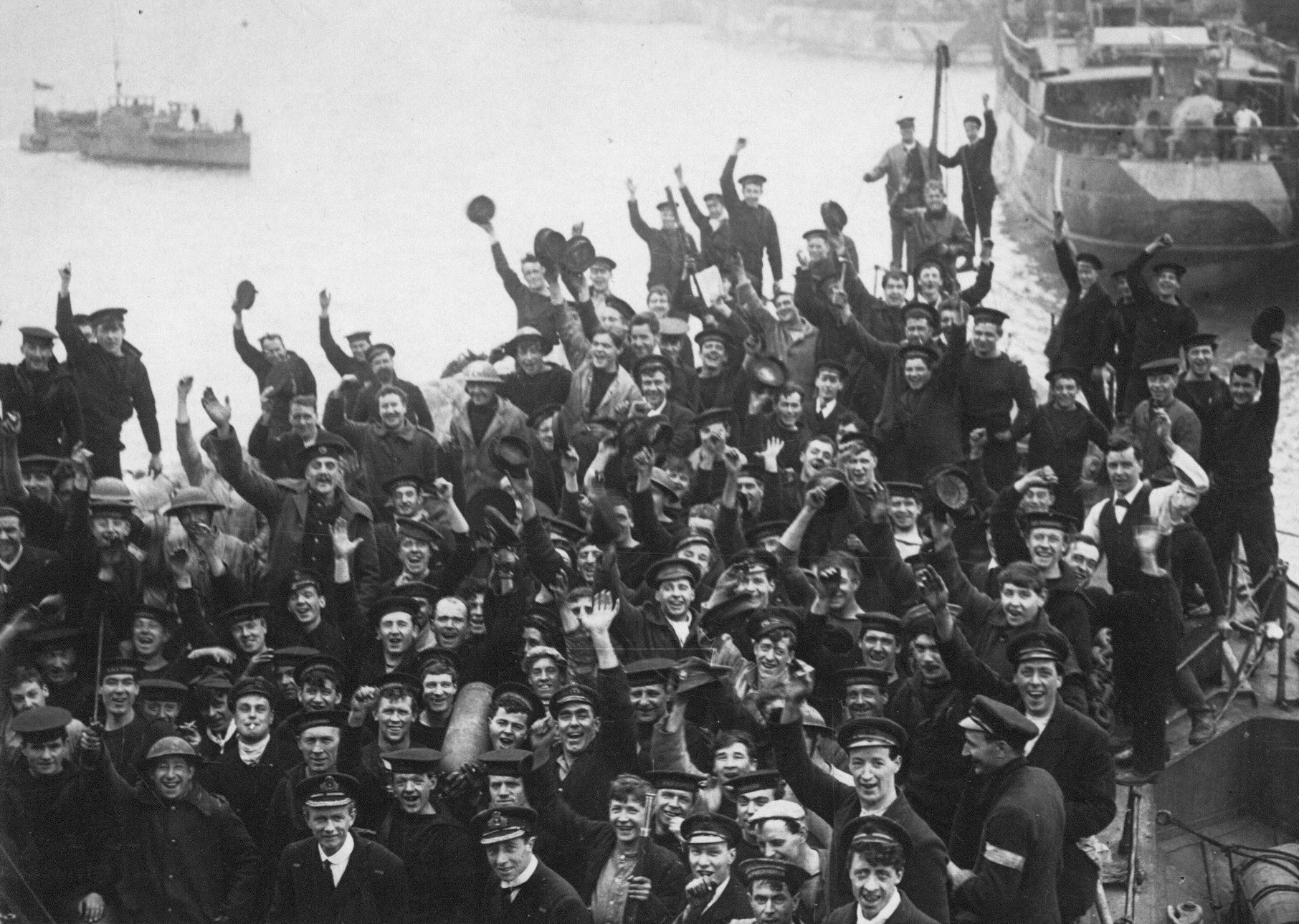
“On leaving HMS Brilliant, we had a look on her port-side, but found no one there, and ML 283 leaving with the crew of HMS Serious. We then started out, but received an S. O. S. call from Commander Benn. On closing him, we found he had rammed a blockship in the dark and crumpled his bough back to the first bulkhead. His exhaust manifold had broken and gassed his two mechanics and another man. We stood by him for a short time and then took him in tow. We parted three lines on him, as his fair leads were gone, and he was shoving six feet of water ahead of him. My port acid tank, used for smoking, had been hit, and we had to keep our hose on it washing acid overboard for hours. This caused smoke, and great credit was therefore due to Sub-Lieutenant Young who had to work in this smoke while passing out lines to Commander Benn’s motor launch. It also made it difficult for me to maneuver astern sufficiently close to pass lines over. We went in with block-ships at 12:30, and at 2 were still east of Ostend. All the small craft had, of course, left for Dunkirk before this. But about 3:30, we picked up a destroyer which stood by us for some time. We arrived at Dunkirk at 6:30. I was not sorry as I had not left the bridge for 12 hours. The HMS Brilliant crew were very enthusiastic, and each man shook hands with me, and when they got ashore cheered us most lustily.”
Chained-shot referred to German Flaming Onions, rapid-fire anti-aircraft and anti-personnel rounds. They were large glowing-green-or-white phosphorus balls discharged in strings of five-to-ten. Because they were launched in such rapid succession and had such bright tracers, they appeared to be physically linked by a chain of fire as they curved through the sky. Despite heavy fire, Roland’s Motor Launch rescued thirty-eight sailors from the sinking HMS Brilliant and towed a crippled motor launch out of the harbour. The letter to John went on to describe the next block-ship operation three weeks later, but that will be in another episode.
Navy Cadet Brock's Eyewitness Account of the Halifax Explosion of 1917
Canada Brock - Halifax Explosion of 1917
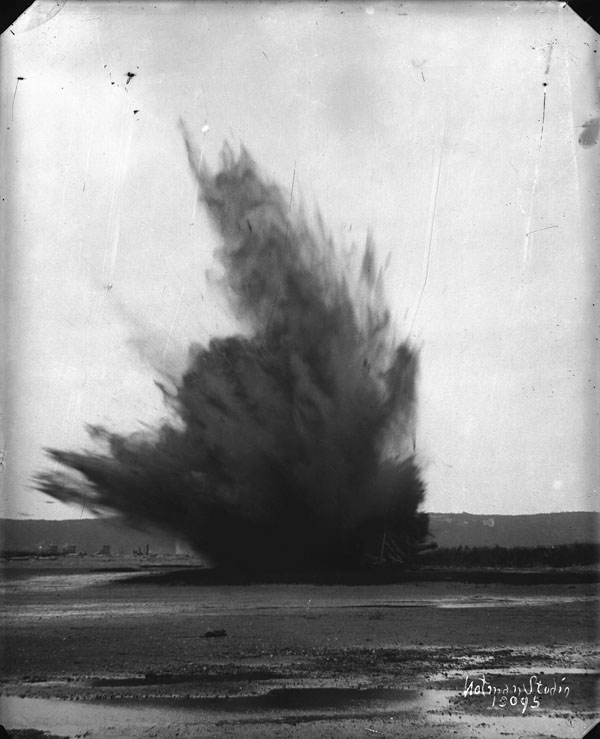
On the 6th of December 1917, two ships collided in the Halifax harbour and caught fire. One of the ships carried explosives for the Great War raging in Europe. The burning vessel drifted toward the Halifax shore, attracting crowds of spectators unaware of the danger. A few minutes after 9 AM, the fire reached the main cargo hold, triggering a detonation of 2.9 kilotons of explosives. The blast flattened everything within a 2.5 kilometre radius, and the shockwave was felt hundreds of kilometres away. On that December morning, Patrick Willet Brock was a 14-year-old cadet at the Naval College, located on the Halifax harbour. PWB recounted this historic event in journals he kept throughout his years at the naval college.
Resources
For more information on the topic of this programme and the sources used, please use the links below. You can also read an article created from the audiogram below the links.
Excellent Article at Legion Magazine: https://legionmagazine.com/features/halifax-explosion/
Halifax Explosion: https://maritimemuseum.novascotia.ca/what-see-do/halifax-explosion
Nova Scotia Archives: https://archives.novascotia.ca
History of the Canada’s Royal Naval College: https://canadiansatarms.ca/history-of-the-rcn/
Royal Military College of Canada, which holds originals of PW Brock’s journals: https://www.rmc-cmr.ca/en
Canadian Forces Base Esquimalt Naval & Military Museum: https://navalandmilitarymuseum.org/
The Halifax Explosion
by K.M. Lowe
The Halifax Explosion on the 6th of December 1917 remains the deadliest man-made disaster in Canadian history. The event is still considered the largest accidental non-nuclear detonation in recorded history. The disaster was caused by a harbour collision between the Norwegian vessel SS Imo and the French munitions ship SS Mont-Blanc, which was carrying high explosives for the Great War in Europe.
Patrick Willet Brock (PWB), a 14-year-old cadet at the Royal Naval College, witnessed the event and wrote about it in the journals he kept throughout his years at the naval college.
The sheer scale of the casualties was immense, particularly considering Halifax’s population at the time was only about 60,000. Nearly 2,000 people were killed—about 1,600 died instantly, and hundreds more succumbed to their injuries later. The dead included more than 500 children and 200 military personnel, many of whom were working at the dockyards. Approximately 9,000 others were injured, with hundreds blinded after watching the burning ship from their windows only to have the blast shatter the glass inward. Many others suffered ruptured eardrums and severe burns. But the crisis went on for days. They weren’t just dealing with the largest man-made blast of the pre-atomic age—they faced a merciless blizzard, a medical crisis, and a frantic search for answers in the wreckage.
The physical destruction was equally staggering.
- The Blast Zone: 325 acres (1.3 square kilometres) of the city’s North End were completely obliterated.
- Buildings: Over 12,000 buildings were damaged, with 1,630 of those completely levelled.
- Housing Crisis: 6,000 residents had their homes destroyed, and 25,000 were left with inadequate shelter.
- Economic Cost: Property damage was estimated at $35 million in 1917 ($700–$800 million today), though the modern replacement cost of the entire district—including docks, railways, and factories—would likely reach billions.
PWB wrote, “Outside points were most generous in their aid. As soon as possible. The injured were sent by train to Truro and other points, where the citizens were most kind to the sufferers. The way in which the United States sent their aid was very generous. Relief trains and ships were despatched.”
Truro, Nova Scotia, sent a relief train within the hour, while Moncton and Saint John dispatched firefighters, equipment, and medical personnel by rail that same afternoon. Prince Edward Island granted $8,000 for relief and sent a contingent of nurses to assist the city’s overwhelmed hospitals.
Perhaps the most famous assistance came from Boston, Massachusetts. Governor Samuel McCall did not wait for a formal request, immediately telegraphing, ”Understand your city in danger… Massachusetts ready to go the limit in rendering every assistance you may be in need of.”
The governor also did not wait for a reply. Before nightfall, a relief train loaded with doctors, nurses, and supplies departed Boston. This forged a bond between Nova Scotia and Massachusetts that remains strong over a century later. In gratitude, Nova Scotia sends a large Christmas tree to Boston every year. In 2025, a 45-foot white spruce was officially lit in the Boston City Common on December 4th, just two days before the anniversary of the explosion.
